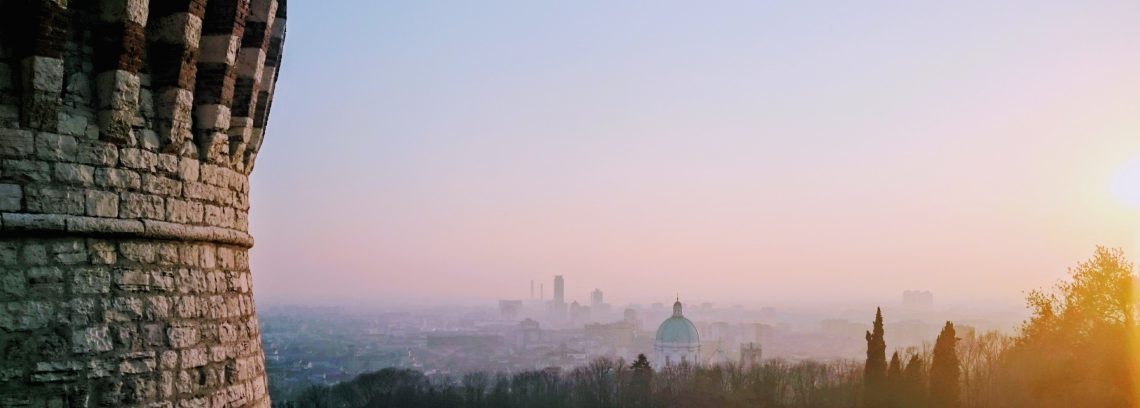
Summer is rough in Brescia. Because of its unique location in the middle of the north, gently nestled in the foothills of the Alps, and about as far away from the sea one can get in Italy, the rarefied air up here tends to settle, stick around, and stick to you. It doesn’t help that by this time it has been threatening to rain for over a week, without a single drop falling, so we’ve reached peak humidity. Adding to our aforementioned air, the fine particulate matter from the marble quarries in nearby Botticino and the large garbage incinerator on the wrong side of the tracks (infamously abused by the Camorra to burn radioactive detritus) ensure that breathing don’t come easy.
To stand outside in downtown Brescia in the heat of summer is like standing next to an indoor pool with a smoking section.
Thankfully, tonight comes a welcome respite, as we delight in the (slightly) cooler climes and compelling culture of a night at the opera in fair Verona. We are very lucky to have this experience with much thanks due to Antonella’s sister, Monica, who has helped organise this outing on behalf of her place of work, which means we receive a group discount, and a delightful ride in a fancy bus passing by the wineries, farmers fields, ancient villages with their medieval masonry, and views of the pure majesty of the cliffs surrounding lake Garda.
Experiencing the countryside of the Italian peninsula never ceases to capture my imagination. While I’m often awed by the sheer magnitude of the Canadian wilderness, as I look out from the confines of the pullman, my mind races to keep up with the images conjured by every detail of the landscape: each field, each tree, each vine, each stone, each brick, each spitting old woman, each swearing young man, each jolly little cloud, each ominous storm front, each renaissance facade upon each medieval tower atop each Roman foundation over each Etruscan excavation has a tale to tell, a tale spun into the intricate and ornately woven tapestry of history, of time. On the world stage the awesome glory of American topography, from Águila to Alert, provides but a subtle backdrop to the frenetic energy, delightful insanity and everlasting education of the Italian melodrama.
Our arrival into Verona doesn’t disappoint.
It’s too bad that Verona, once a jewel of The Most Serene Republic of Venice and veritable tour de force in its own right, is now best known as the setting for a couple of plays by some long-dead British guy. Graciously, the city and its history have deigned to stay very much alive and Verona’s long-lived vivacity is quickly demonstrated as our coach circles the city centre, passing the grandiose Porta Nuova and the earth and stone embankments of the ancient defences before crossing the Adige river, giving us a spectacular view of the centre from the north side, replete with Roman bridges, medieval castles, and modern aperitivi.


What a way to enter a city! If you know anything about powerful medieval families of the northeast of Italy, you can instantly recognise who built this bridge, especially if you’ve seen some of their very well preserved work around the region. The Scaliger family, a.k.a. Scaligeri or simply the Ladder Bros., once controlled a large swathe of land from the Dolomites to the Ligurian Sea where they built some pretty incredible works, which themselves have grown into their own very real and very imagined histories.
After crossing the Scaliger bridge and through the Scaliger castle (neither ladders nor stairs were to be found), we are properly in the city centre of Verona. A brisk walk through bustling streets brings us to our first surprisingly unsurprising military checkpoint. I never get tired of being given the stink-eye by baby-faced teenagers holding assault rifles wearing forest camouflage surrounded by limestone and marble. The brightly coloured and beautifully decorated concrete barriers provide a whimsical contrast to the staunch and stern need to intimidate immigrants.


Turning my back on reality, I can once again embrace the magic of the evening. We are now facing a gorgeous piazza, fountain in the middle, surrounded by the festive atmosphere of long lunches turned happy hours, and the impressive, magnificently preserved, amphitheatre in the distance.
There’s a lot to be said about the theatre itself as it’s older than the Colosseum, could seat thirty thousand and, despite earthquake and invasion, has survived the last two thousand years to now liven up over the last one hundred with a continual succession of spectacle (minor breaks for world wars notwithstanding).
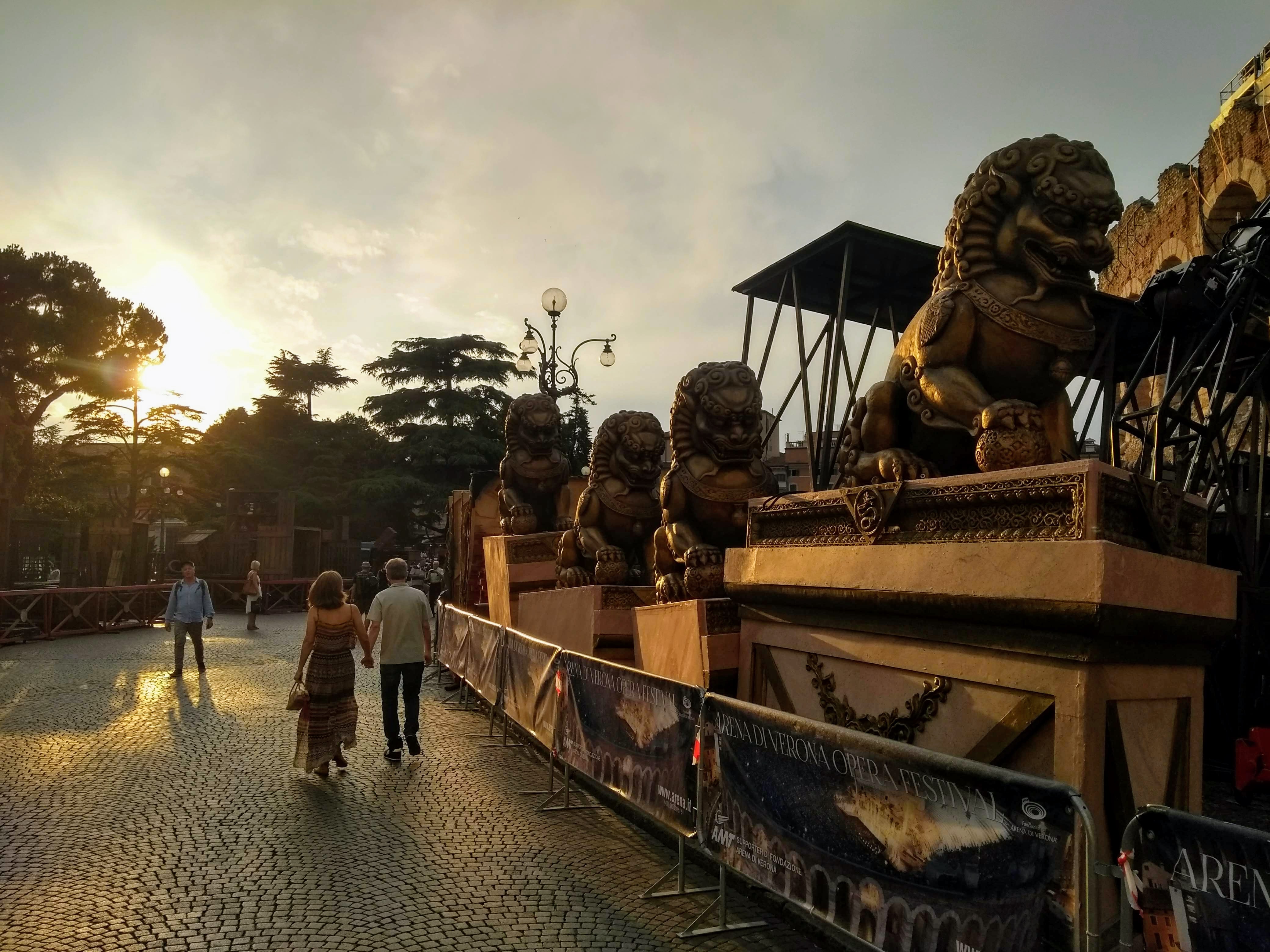
Approaching our gate, I’m amazed at the set pieces on display. I know that the arena hosts several operas throughout the summer season, but I assumed they’d do them each one at a time, organising their casts and crew, and moving things back and forth from secure storage, not shuffle like mad through their repertoire. If I were a student of opera or music or theatre, I might be able to discern which groups of props belong to which masterwork, but I haven’t a clue and am left solely in admiration for the grand logistical wrangling it must take to reset a stage such as this.
I’m also a little nervous to get through security, as to stave off hunger and thirst and the looming storm, our bags are over stuffed with supplies and provisions. Bottles over five hundred millilitres are verboten, so I have five of precisely five decilitres each. Several sandwiches, plastic pants, undersized umbrella, and rolled up raincoat fill out a potentially unpretentious pillow should I need a rest. I feel well prepared, and I think the security guard agrees as he waves me through with an incredulous eye roll and a chuckle. Little does he know it will all come in handy.
We enter, have a quick bathroom break, and find our seats.
Next stop: the show!
 A Nix in Brixia