
Some wayward recollections that come to mind while I while away in limbo:
Pena un scudo e perdita de panni per chi lava in questo fonte. “Whoever washes in this fountain will lose their clothes and must pay a scudo!”
In medieval walled cities built of the stone of the mountains upon which they reside, there weren’t too many frothing springs, flowing rivers or familiar lakes from which to draw water. Usually, one would have had to walk quite a way in order get to the nearest source. Somehow, the ancients figured out how to squeeze water from a stone, and as a result cities like Assisi have many public wells. At the time, however, the wells were strictly for drinking, so it was verboten to muck around in the water for any other reason, especially for rinsing out one’s dirty undies! Heaven forbid one be caught bathing in such a fountain, have their money and clothes taken from them, then be forced to make the long walk of shame back home, where the waste-water of the rich above was probably pooling in their living room.
Naturally, these beautiful fountains are no longer potable by EU (or any sane) standards.
(Remind me to tell you the story of a pool of water following me from the top to the bottom of Assisi–since literally all surfaces are stone, it just wouldn’t stop!)
Santo Stefano church in Assisi is a tiny little thing dating back to the middle of the 12th century. Dedicated to the first Christian martyr, and nestled in the city centre in a back alley, Saint Stephen’s was built in the Romanesque style and remains typically Umbrian (which means simple, since it’s so darn old I imagine), not having been changed much from it’s original construction.
There is one later addition to the facade, a small arched niche, where there is a very faded medieval fresco. In fact all over Assisi there are similar niches, all with ecclesiastical motifs, either from the lives of saints (most likely St. Francis), depictions of the Madonna and child, or one of a myriad of angelic themes. I wonder if they were a way of identifying streets or churches or houses, or if they were implemented as a constant reminder to the locals that theirs is most definitely a Catholic city.
The church inside is equally adorable, yet the sanctity is palpable. This is a place of quiet and intimate meditation. Looking around, I can still see parts of original frescoes, work unattributed, lending themselves to the subtle mystery permeating through the modest space. Above the altar is a simple metal crucifix, drawing my eyes upward and moving my thoughts to consider loftier ideals. In almost a thousand years, how many have been in this exact spot? How many have offered a quiet prayer for another or knelt in humble supplication?
We are enjoying dessert after lunch in Perugia at the same restaurant we had enjoyed the day before, with a delightful young lady serving us. Naturally, I ask for a caffè doppio, which is a double espresso, since what we call espresso is just plain ol’ coffee in Italy, and good luck finding it any other way.
Did I mention our server was delightful? Well, as she dropped off my tiny little cup o’ joe, I could swear that her visage turned quasi-maniacal. What’s this? It’s not a double, but clearly a single! I want a caffone (big coffee, not actually a word), not a caffino (small coffee, not actually a word)! Can you believe it?! Then, she had the gall to actually explain to me that so much coffee at once just isn’t good for a person and that I should be more mindful of my health. Nonsense! Don’t coffee shame me! I know my own body and I won’t be put down! Besides, I’m still jet lagged and I drank too much wine last night, so let me have this treat so I can get on with it! Of course Antonella agrees, and since she had to translate anyway, the server is gone and my teensy bit of concentrated roasted bean juice is cold. La dolce vita indeed.
Still in Perugia, in the museum below the cathedral of San Lorenzo, which I described in my previous post, we met a man.
Now, this tour isn’t particularly exciting, in the Disneyland sense. What makes this a truly magical wonderland was our magnificent guide, who is so elegantly able to parse the subtle demarcations of stone left after each generation of civilization had passed on. I mean, we are literally looking at bricks and dirt for an hour.
Ecce homo, disposition dour, anxious in arrival, he is the last to purchase a ticket. I’m not sure if he didn’t quite know what he was getting himself into or if he knew exactly what was up and was down for what he got out of the whole experience.
As we enter the second level of excavation, it seems like he’s asking if he can leave the group and wander alone. The guide doesn’t know what to make of it, as he obviously can’t speak Italian, but she tries to explain that without explanation the rest of the space would be rather dull. Despite her seeming trepidation (I suppose, since I don’t speak Italian either), she allows the gentleman to leave us and explore on his own. We don’t see him for quite some time.
At our fourth stop along the way, while admiring a dirt slope surrounded by bricks (it is theorized that this interior sledge was used to move said bricks ever higher), the nervousness of our guide is too much for her to bear, and she has to call security. There’s only one way in and one way out, and that way is securely locked, but still there is the thought that maybe he will find a particularly pretty piece of pottery to pilfer and smuggle it out in some miraculous manner.
As soon as she’s finished her call (how good is cell service in Italy that one can place a call in the centre of a literal mountain?!) the man rushes past behind us. Taking chase, she catches up with the man, and unable to get his attention by shouting directly at him, she’s forced to lay hands upon the charlatan. Wheeling around, he gives a quizzical look and keeps walking nonchalantly, as if nothing were the matter. At that moment, from the only point of egress in our spacious vault, a security guard arrives, and the two gentlemen leave together.
Anticlimactic yes, but still a weird tale. Was he actually on the lookout for ancient artifacts, or merely providing a dead drop for secret intelligence? Perhaps he was making a bit of history himself and hiding alien figurines for future generations to puzzle after. Or perhaps he simply didn’t understand a word, saw that there was nothing but stone, and longed for home. Who’s to know? Not I, of course.
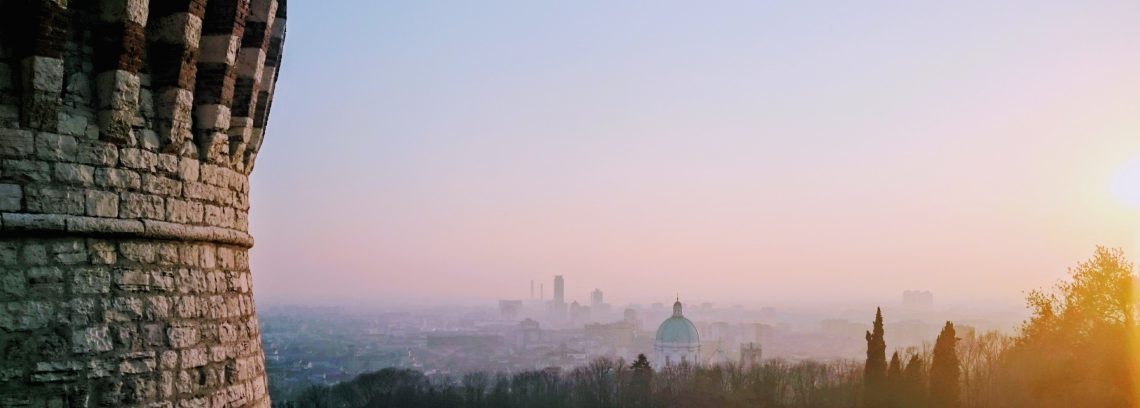
 A Nix in Brixia