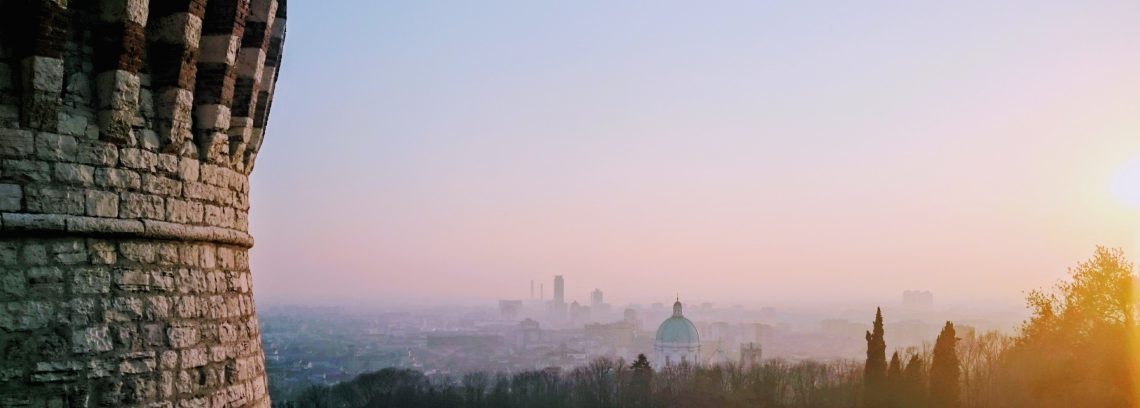
In a sense, I’m thankful that I’m still not able to sleep through the night. It’s 5:30AM and our alarm is going off while I slowly put down my book and find my socks.
Socks are on! Bags are packed! Teeth are brushed! We arrive at the train station just after 6 for our 6:30 departure, which brings us from Brescia, through Verona straight to Rome; after a brief snack break, we’re headed to Foligno before our last transfer to Assisi!
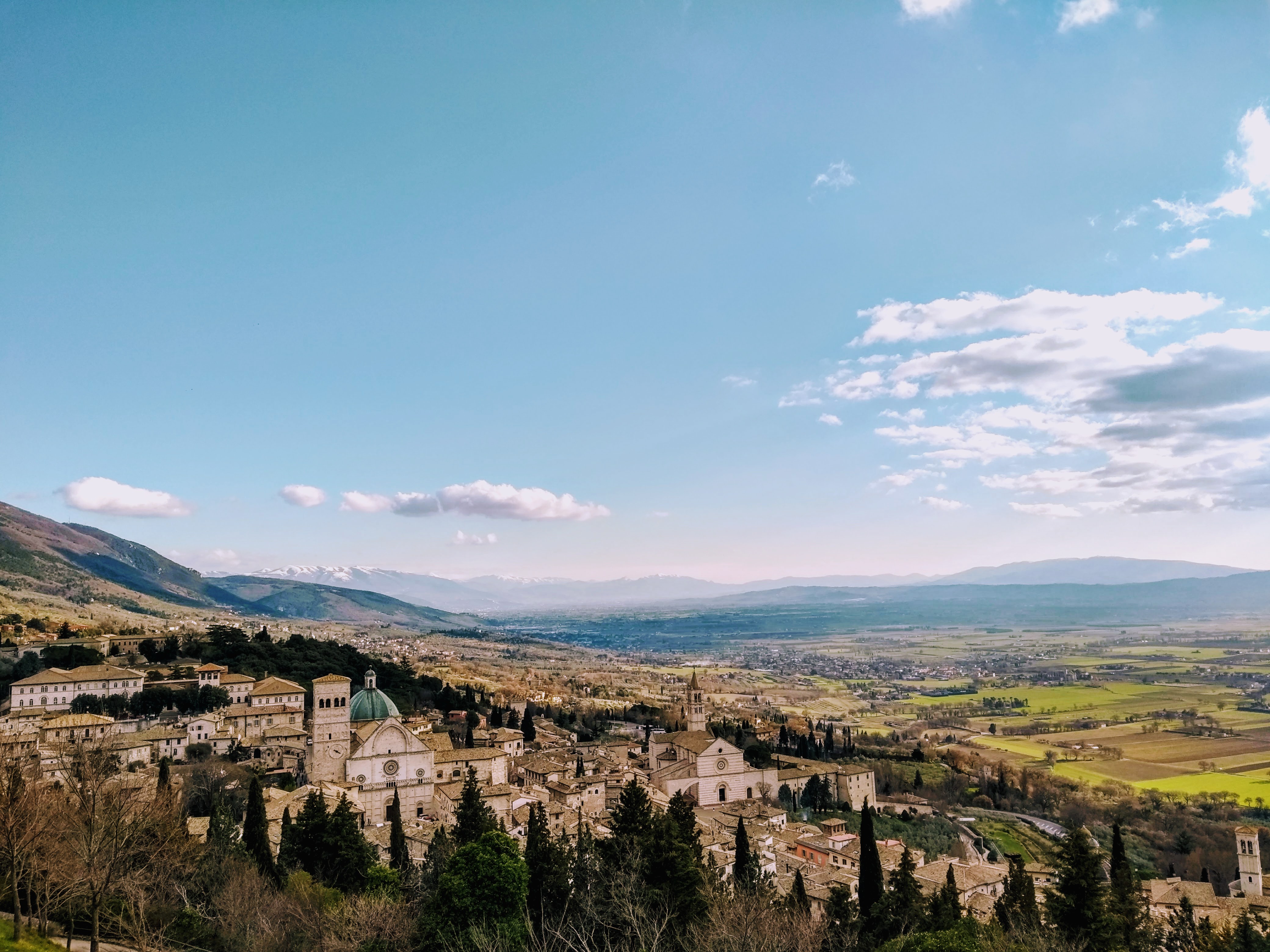
Assisi is an ancient city on a hill in the mountains. Once central in the struggle of the Holy Roman Empire and the Papal States, Assisi is now (at least in February!) a quiet little tourist town, a UNESCO World Heritage Site, and home to St. Francis of Assisi and his order of Franciscan friars that still minister here and around the world.
It was actually on a pilgrimage to Assisi with the friars where Antonella and I first met, so Assisi has a special place in my heart.
Leaving the train station by bus, we slowly wind up the hillside, being treated to a uniquely clear view of the valley below, with crystal peaked mountaintops visible in the distance. I’m told such clarity is unusual for the time of year, as the valley tends to collect the cool, humid air of winter in Italy, forming it into a thick wet blanket of fog (it looks magical from above at least!).
After arriving and getting settled, we spend some time slowing wandering up and down the stone roads across the small city. First we decide to head to the Basilica of St. Francis to spend some time in quiet reflection. As we approach the spiritual centre of this city of peace, we’re surprised to see a small cadre of soldiers guarding barriers blocking the various entry points, and herding us down toward the lower piazza where our bags can be searched and we can be pat down before being allowed to pass.
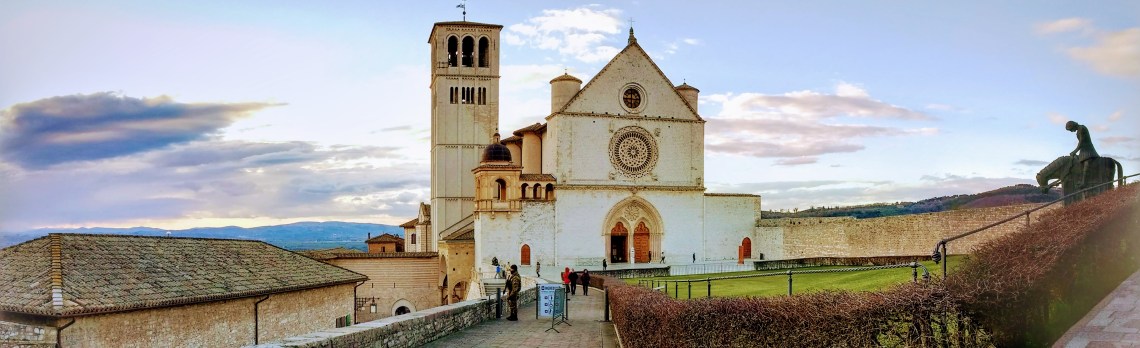
This show of force seems to lie in stark contrast to the vulnerability presented by St. Francis and his followers in their service to the poor, but since an election is coming up, such bravado is necessary so people know the government is still in control. I’m not sure if that’s true, but it has the opposite effect on me.
Regardless, we’re able to pay our respects to St. Francis in the tomb below the basilica and spend some time in silence together.
Next stop: dinner! I’m a pretty picky eater, in the sense that while I’ll try anything once, if I don’t like it, there’s no need for me to try again. So, when I find something I like, I tend to stick with it. In this case, it’s the awesome restaurant tucked away in an alley just above the Piazza Comunale and just below the cathedral of St. Rufino (first bishop of Umbria circa 238), La Lanterna. Instead of going into salivating detail, I’ll just leave the hipster food photos I’m able to take. Everything is amazing, and we will eat there all three nights in Assisi.


Our second day in Assisi has us rising late to meet with an old friend and colleague of mine, friar Dan! Dan is an awesome man, and when I heard that he would be in Assisi at the same time we were I had to try and meet up with him. Thankfully despite his busy schedule, Dan was able to make some time for us and invited us to the Sacro Convento for lunch!
Now, the word around town is that despite their vows of poverty, the friars of the Sacro Convento (literally, ‘sacred convent’) are pretty spoiled when it comes to mealtimes. However, it’s Ash Wednesday, the first day of Lent, so things are a little less lavish than rumoured (even plain pasta is amazing here though). In the grand papal salon, a really fancy dining room, we’re joined by about fifty friars and their guests from all over the world, visiting, studying nearby, or ministering to the pilgrims who come to visit year-round.
After lunch Dan is gracious enough to take us to the grand portico overlooking the Umbrian valley. It’s a real treat and one of my favourite places in Italy, and not many tourists are able to enter, so I feel extra special (since the Sacro Convento is the private home for the friars in Assisi, their balconies aren’t exactly open to the public). Dan further indulges us with coffee and patience as Antonella and I attempt the perfect selfie.


Now, I have in my notes here the sentence: “unholy destruction of a holy toilet” but I think I’ll let it stand on its own. Needless to say, that was our last stop before continuing on with our day.
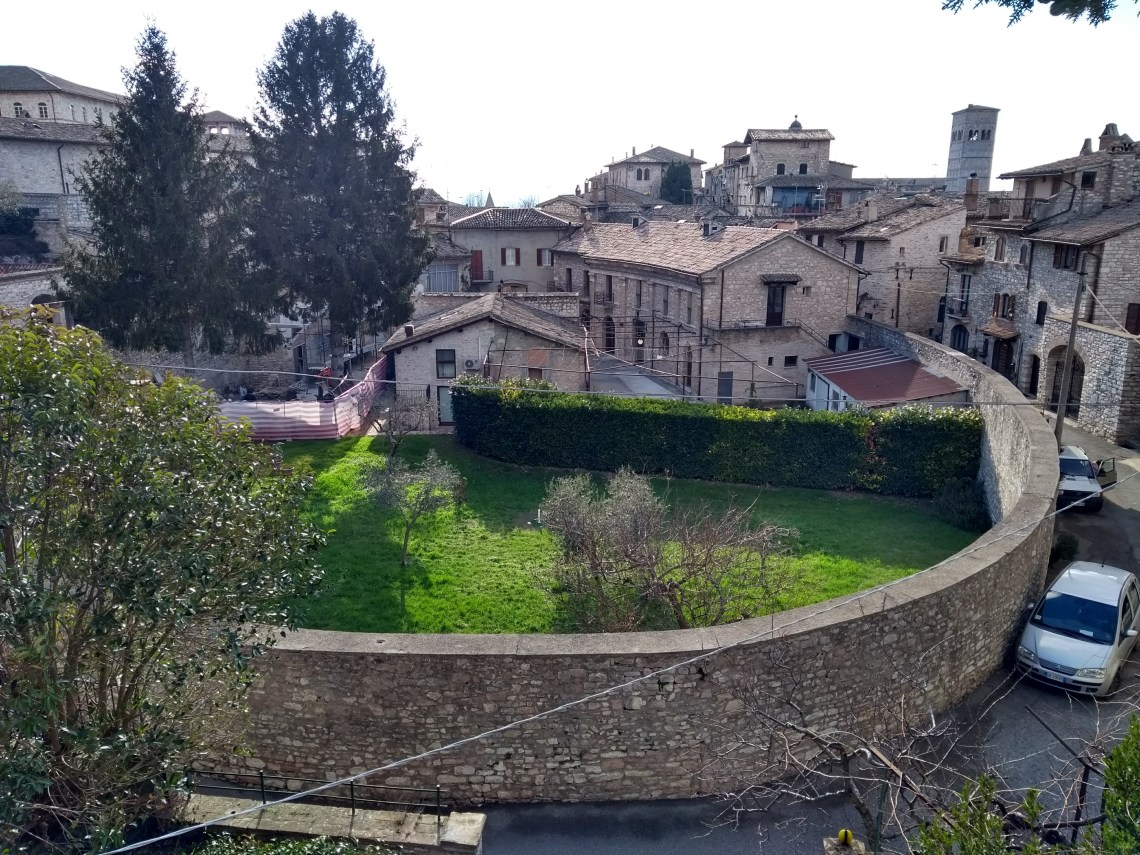
Feeling much lighter, we’re off in search of higher ground! From the farthest western point of town we walk up and across toward the Rocca Minore, a guard tower at the highest point of the eastern wall. Before the final ascent however, we sneak through a small residential area and stumble across a tiny Roman amphitheatre, which is now the back wall to someone’s garden!
When I think of Roman architecture, I think of the grand structures I’ve seen in Rome and Brescia with magnificent columns and imposing fortifications. While this small amphitheatre retains the stoic dignity of Roman craftsmanship, it’s just so darn cute! I can’t even imagine living in such a part of history, but it seems the majesty of their surroundings is lost on the locals as they give us dirty looks for daring to be in awe. (Side note: everyone hates tourists in their hometown, so I don’t really blame them. How many people have I bumped into in downtown Toronto because they’re too busy gawking upward and not watching where they’re going! The nerve!)
After a brief assault of the Rocca Minore (it was closed), we’re back down and then back up again all the way across the city once more to the Rocca Maggiore. This is the main fort atop the hill. This is the fort the residents stormed to kick out the imperial authority of the young Holy Roman Emperor Frederick II over 800 years ago.
There are some fun displays of the yearly festival Calendimaggio where the Assisians dress up in costumes from the medieval era to ring in the springtime, and there are some cool weapons and armour and a fun book which we can sign with a fancy quill pen. Neat!


Knees creaking, we make our way back down the mountain to the Lower Basilica to receive our Ash Wednesday ashes. I have to say that at this point my Italian has progressed enough that I can begin to understand most of what’s being said now, with a few caveats, of course. When someone with a clear accent is speaking to a crowd of foreigners and deigns to be understood, well that’s just dandy! After Mass, I’m feeling uplifted despite the traditionally sombre tone of the beginning of a Lenten journey, and we’re beginning to feel a little peckish, so that means it’s aperitivo time!
Right next to the Piazza Comunale (where there’s the Temple of Minerva turned church, aptly named Santa Maria sopra (above) Minerva) is a terrible little bar, where we receive, and grudgingly pay for, the worst cheese plate I’ve yet encountered. The cheese itself is fine, I mean, it’s cheese, there’s just not much of it. However, the main disappointment comes in a frozen puck of jelly that’s meant to be jam that just doesn’t want to be eaten. We indulge the poor thing and leave it be.
I’ve seen Antonella truly upset now only a couple of times. First, when dealing with the nonsensical bureaucracy we faced in our first days, and now here. It’s my fault for speaking in English, as the servers probably didn’t realise Antonella is Italian and therefore has standards. I can’t decide if she’s terrifyingly cute, or cutely terrifying.
After paying we leave for a better restaurant.
Our final full day in Assisi offers us our most ambitious itinerary. We’ve decided to make the long walk (this is the pilgrimage bit) to Santa Maria Degli Angeli, the small town in the valley which hosts the tiny church (also called the Porziuncola) of the same name where St. Francis and his merry band got their start, and where St. Francis died. This tiny 1200 year old structure is now enclosed by the opulent monstrosity of the basilica built on top of it.
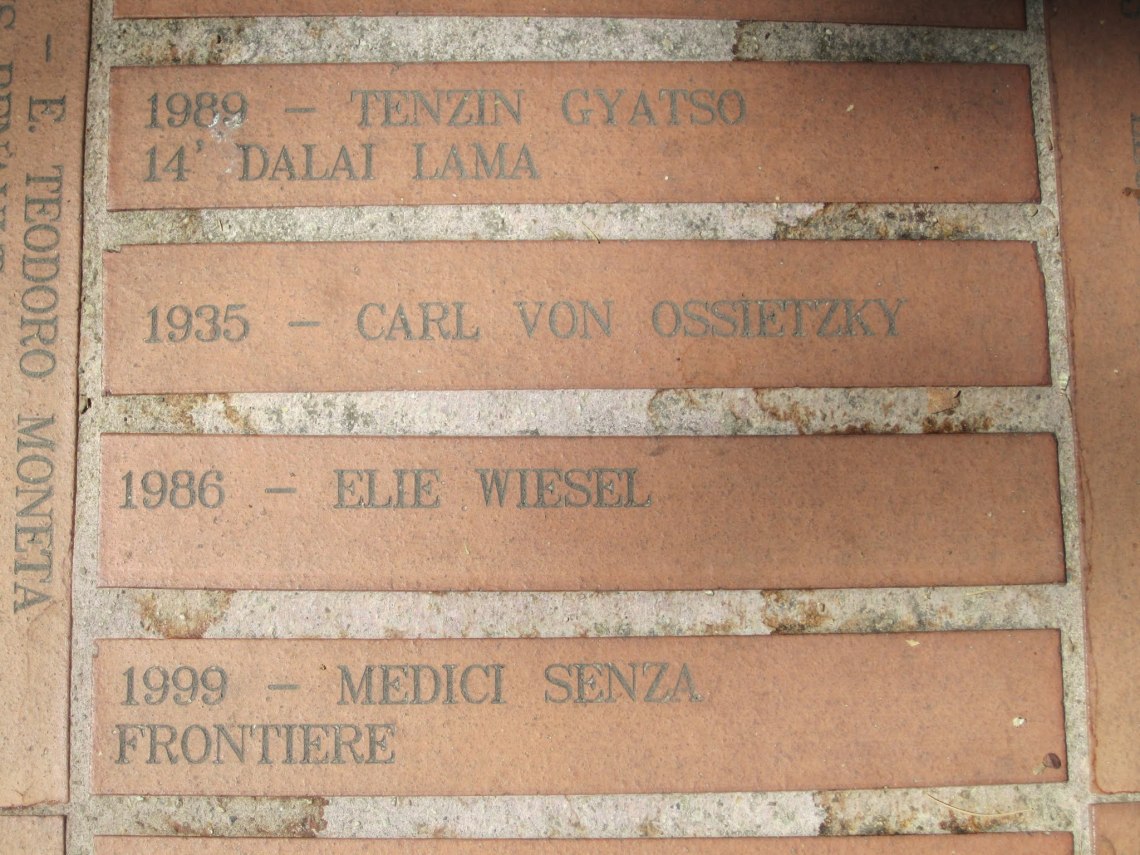
Directly from the southern wall of Assisi is the pathway that leads to the Poziuncola, only about 5km away. Each brick is engraved with a dedication (I imagine the sponsorships help offset the costs of said bricks), and we have fun trying to spot names and cities we recognise. It’s cool and sunny, with mysteriously clear skies once again, so the walk is a delight.
To fulfill an inside joke with an old friend, we stop at the first restaurant we encounter, McDonald’s. It’s absolutely disgusting and I love every second of it.
Finally we’re here! Greeted again by the ever vigilant military, we’re casually waved through to the square in front of the church. As I may have made apparent before, the sight of this place to me is… a bit much. However, the tiny little chapel enshrined within is truly a sight to behold. While it’s been rebuilt (by Francis himself!) and refurbished since the 9th century, spending some time between the narrow stone walls really gives one a feeling of the presence of history, and the mystery that draws so many to such a simple place.
The rest of the surroundings I can do without. From the signs pointing out precisely where the saint has died; to the clipped wings of the doves who can’t bear to leave such a holy place; and the thornless rosebushes that were rendered impotent by the touch of Francis as he tried to wound himself to distract from his corporal temptations; the legendary kitsch adds nothing to my experience except to reinforce the idea that all believers are merely human, even friars and saints, and the lights can’t keep themselves on.
We exit through the gift shop.
The walk back toward Assisi is a little more difficult, as we’re beginning to feel the fatigue in our knees, so after a brief stretch break, we continue onward and upward! Our next stop is the convent of San Damiano, outside of Assisi, just south of the Porta Nuova (the new gate). Unfortunately, the shortest route to get there is a steep walk up, an awkward circuitous highway walk east, then a steep walk halfway back down the hill. We should have planned our route better, but Antonella won’t let me cut through strangers’ olive groves.
The convent was the home of another great Franciscan saint, St. Clare, the spiritual sister to Francis. Because she was a woman in the 12th century, she and her sisters were not allowed to travel the world preaching as the friars were, but had to remain cloistered, in service to the world through prayer. Ironically, while in her lifetime she wasn’t allowed to practice the radical poverty of the Francis, her home remains the most humble of the Franciscan sites, lacking in post hoc ostentation, a true display of Clare’s worldly humility.
The convent, chapel and grounds are probably one of my favourite spots around as well, providing bright sunlight, cool breezes and great views that culminate in a true sense of the sublime. If you have a moment, visit and just sit still for a while.
After a slow and achy walk back up the hill, we indulge in wood-fired pizza, and call it a night! Next stop: Perugia!
 A Nix in Brixia